
Each month, we share insights from one of our network’s extraordinary researchers.
Each month, we share insights from one of our network’s extraordinary researchers.

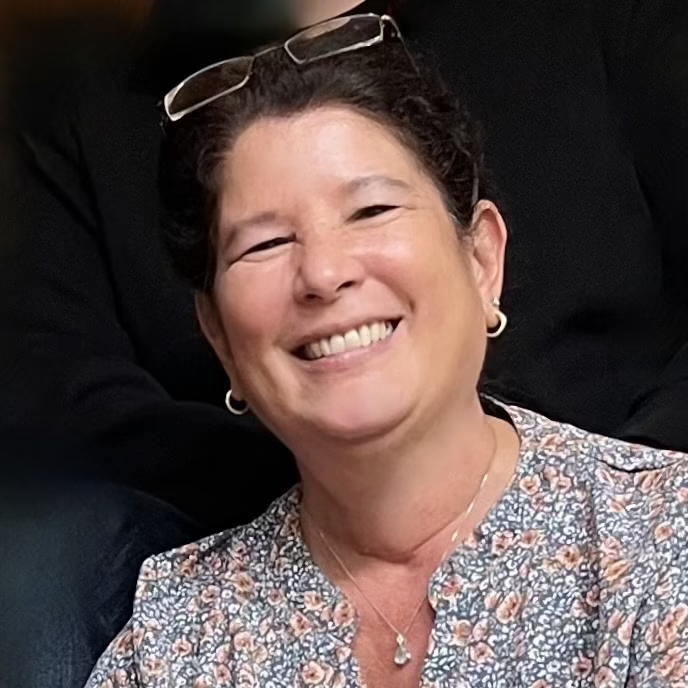
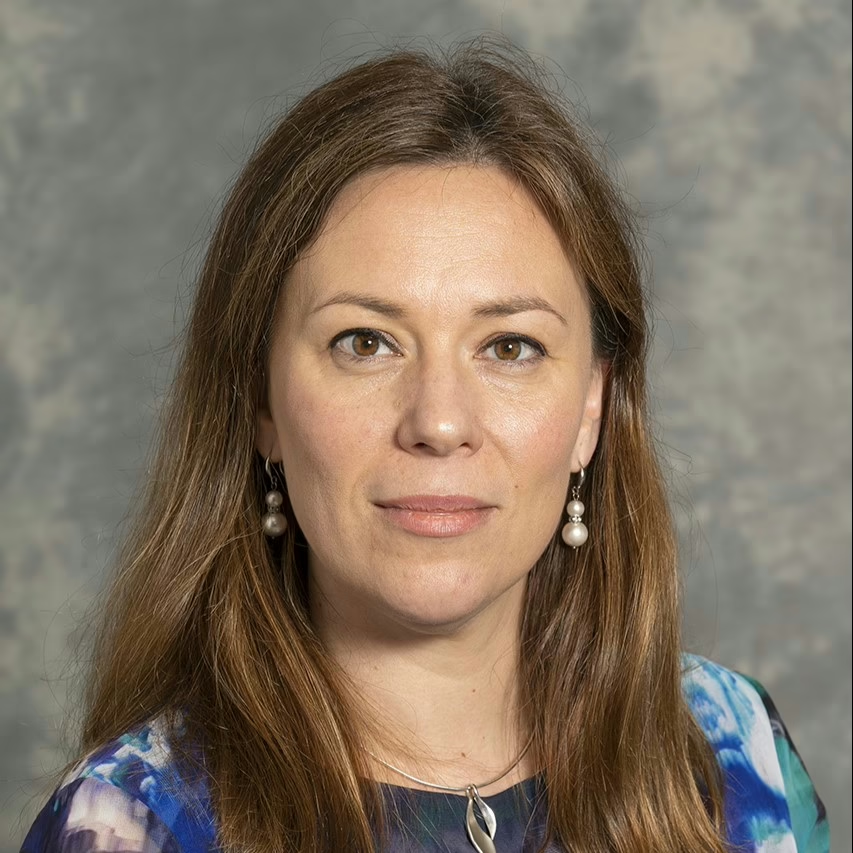
Dr Stephanie Macmahon
Senior Lecturer, School of Education; Co-Founder & Program Director, UQ Learning Lab, The University of Queensland. Brisbane, Australia
Dr. Stephanie MacMahon came to the Science of Learning through the classroom. As a teacher and school leader for more than 20 years, she saw first-hand how much relationships, emotion, and context shaped whether students actually learned — and how little room busy, outcomes-driven school systems left for those dimensions. When she encountered the field at the start of her PhD, she found an evidence base that finally matched the complexity she had witnessed in practice. That encounter set the direction for everything since: turning research into something educators and workplaces can actually use.
Her work now spans research, teaching, leadership, and advocacy. She has developed and implemented a model of knowledge mobilization that has helped educators in over 100 schools engage meaningfully and sustainably with the Science of Learning in their own settings, and she led a project that co-designed and scaled this approach across an entire educational sector — reaching 147 schools, 12,000 educators, and 76,000 students. Beyond schools, she works with high-risk industries such as mining, applying research on learning to improve workplace training, safety, and wellbeing. As Co-Founder and Program Director of the UQ Learning Lab, she leads a multidisciplinary team that partners directly with educators and industry to put this work into practice across diverse settings.
Description of her work
Dr. MacMahon’s research centres on human connection and learning — how social synchrony, relationships, and context shape cognitive, affective, and social engagement across the lifespan. A defining thread of her work is knowledge mobilisation: building practical, sustainable models that help educators and organisations engage meaningfully with research rather than adopting it as a checklist. She is also a vocal advocate for what she calls the “REAL” Science of Learning, pushing back against a landscape where the scientific disciplines has often been narrowed to purely cognitive, prescriptive practices. She advances this view through invited keynotes, professional learning programs for schools and industry, undergraduate and postgraduate teaching, and a textbook currently in development with Cambridge University Press.
Key findings
– Treating educators as active partners in research — rather than passive recipients of it — leads to more meaningful and sustained change in classroom practice, as demonstrated across a 147-school, 12,000-educator, 76,000-student sector-wide rollout.
– Social synchrony between teachers and learners is not a peripheral “soft” factor but a core mechanism of engagement, relevant from P-12 classrooms to high-risk industry training.
– Reducing the field to purely cognitive or prescriptive strategies strips out the affective, social, and contextual dimensions that make learning genuinely effective — a fuller application of the science requires holding all of these together.














 English
  Spanish
  French